
Development of an Adaptive Multi-Criteria Optimization Framework Using the PSI Method: Validation via Thermal Insulation Selection
DOI:
https://doi.org/10.54327/set2026/v6.iS1.342Keywords:
PSI method, Adaptive multi-criteria optimization, Synthetic profile, Feedback loop optimization, Two-stage optimization, Optimal insulation thicknessAbstract
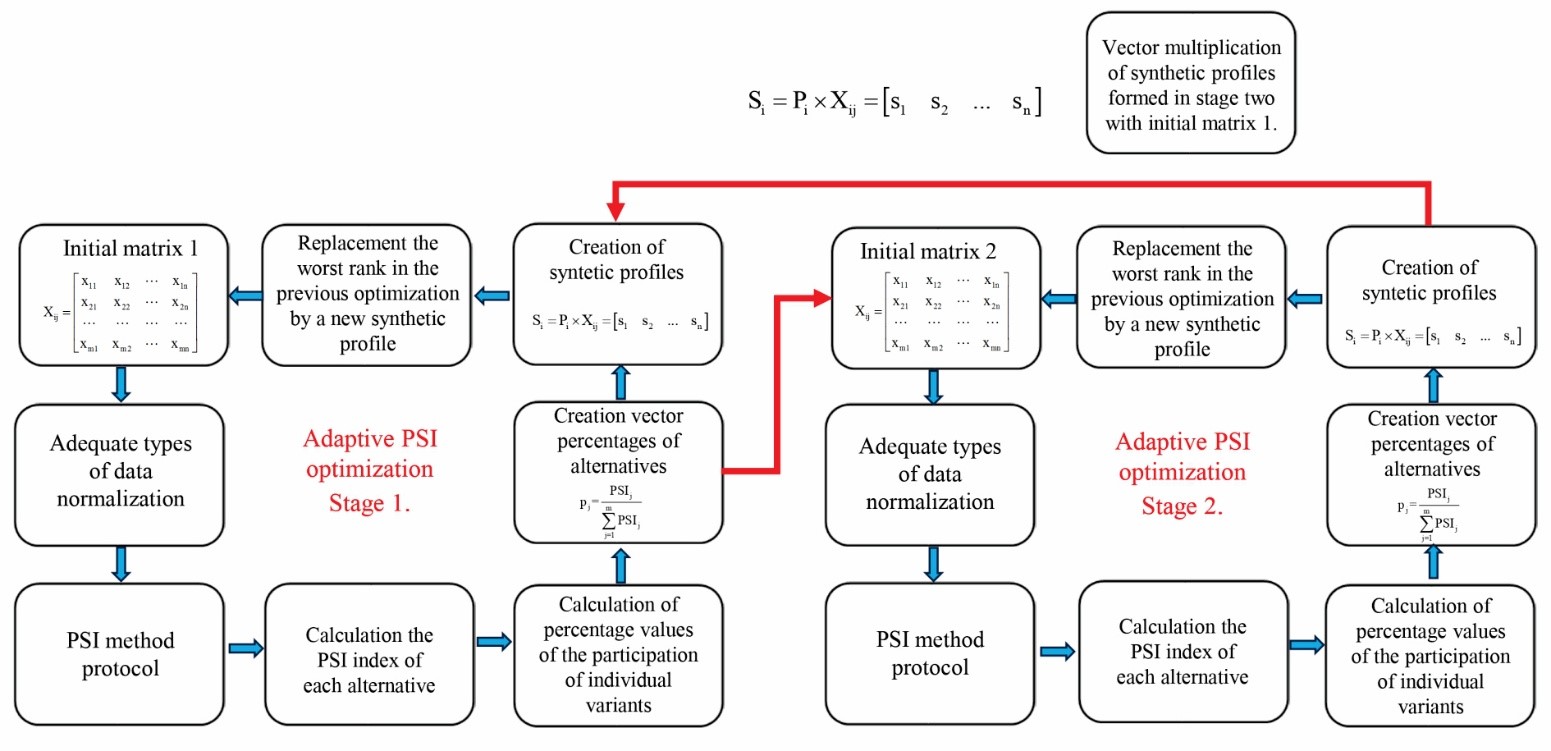
Multi-criteria optimization is primarily utilized to rank various alternatives and project types. However, the question arises: is it possible to use the multi-criteria optimization process for something more than that, in terms of determining the actual set of optimal criteria and creating optimal paths of their changes according to desired constraints? In this regard, it is necessary to find a connection between the output provided by multi-criteria optimization method itself and a hypothetical alternative that represents the current optimal alternative, referred to as a synthetic profile or transit optimum, which does not represent any initial alternative in the optimization matrix. Such an actual transit alternative is formed by the mutual influence of all factors in the decision matrix, but also depends on the multi-criteria optimization process itself. This requires the creation of a mathematical feedback loop between the optimization process and the redistribution of all alternatives according to the criteria, to create a new transit optimal set of criteria. As a representative method for multi-criteria optimization, the PSI (Preference Selection Index) method was selected because of its advantages in terms of its integrated procedure for calculating criteria weights and its objectivity in categorization. The proposed adaptive PSI framework introduces a synthetic profile that enables iterative feedback and two-stage optimization, transforming the classical static ranking into a dynamic adaptive process with a clear methodological advancement over existing MCDM techniques. The overall concept was tested on the optimization of thermal insulation thickness for walls under the conditions of Bosnia and Herzegovina.
Downloads
Downloads
Published
Data Availability Statement
Supplementary materials and data used in this research are accessible upon request. For access, please contact the corresponding author via [srdjan.vaskovic@ues.rs.ba].
Issue
Section
Categories
License
Copyright (c) 2026 Srđan Vasković, Petar Gvero, Milovan Kotur, Đorđe Vojinović, Ljubiša Preradović, Danijela Kardaš-Ančić, Milan Pupčević

This work is licensed under a Creative Commons Attribution 4.0 International License.
Authors are permitted and encouraged to post their work online (e.g., in institutional repositories or on their website, social networking sites, etc).


 © SET Journal