
Computational Sustainability for Climate-Resilient Materials: AI-Driven Decarbonization Pathways for Cement and Industrial Systems
DOI:
https://doi.org/10.54327/set2026/v6.i2.351Keywords:
Computational sustainability, Cement decarbonization, Artificial intelligence, Machine learning, Life cycle assessment, Carbon capture and storageAbstract
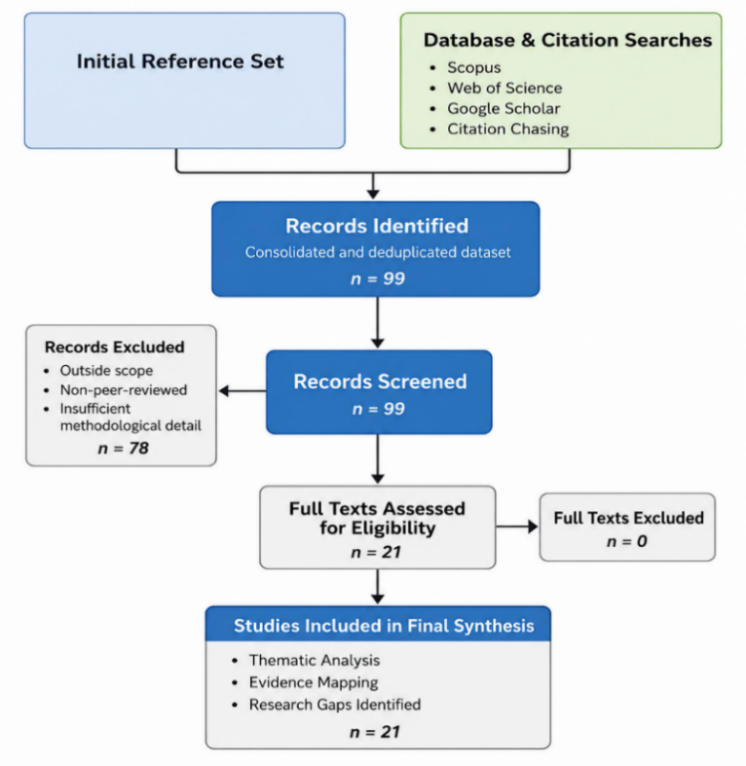
Cement production remains a major industrial source of anthropogenic CO₂ because emissions arise from both limestone calcination and high-temperature fuel combustion. This review examines how computational sustainability can support climate-resilient and low-carbon cement production by integrating artificial intelligence (AI), machine learning (ML), digital twins, optimization, life cycle assessment (LCA), techno-economic analysis, and industrial systems modeling. An interdisciplinary scoping review was conducted using Preferred Reporting Items for Systematic Reviews and Meta-Analyses Extension for Scoping Reviews (PRISMA-ScR) informed procedures to synthesize evidence across materials discovery, cement and concrete mix optimization, plant operations, LCA integration, and system-level decarbonization planning. The review identifies computational sustainability as a multi-scale decision-support framework that links materials design, plant operations, supply-chain coordination, and policy/system planning. The synthesis shows that supervised learning, ensemble models, physics-informed neural networks, explainable AI, multi-objective optimization, digital twins, and system dynamics can support low-carbon binder screening, SCM optimization, kiln control, predictive maintenance, environmental-impact assessment, and infrastructure planning. SCM-based clinker substitution and energy-efficiency improvements are the most mature near-term options, while alternative binders, electrification, hydrogen integration, and cement-specific carbon capture, utilization, and storage (CCUS) require further validation, cost reduction, infrastructure development, and alignment with standards. Critical gaps remain in open and representative datasets, external model validation, uncertainty quantification, long-term durability evidence, multi-plant field trials, and integrated prospective LCA–techno-economic–system modeling. The review concludes that computational sustainability can accelerate cement-sector decarbonization when data-driven prediction, physical constraints, environmental assessment, economic evaluation, and policy-aware systems planning are integrated into transparent and validated decision frameworks.
Downloads
Downloads
Published
Issue
Section
Categories
License
Copyright (c) 2026 Oluwafemi Ezekiel Ige, Prof. Musasa Kabeya

This work is licensed under a Creative Commons Attribution 4.0 International License.
Authors are permitted and encouraged to post their work online (e.g., in institutional repositories or on their website, social networking sites, etc).


 © SET Journal