
An Experimental Study on the Response of Passive Piles in Soft Clay
DOI:
https://doi.org/10.54327/set2027/v7.i1.409Keywords:
Passive Pile , Soft Clay, Horizontal Soil Movement, Bending Moment, DeflectionAbstract
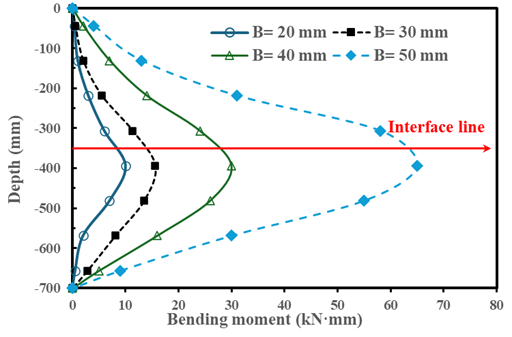
This paper experimentally evaluates the behavior of model piles in a clayey soil exposed to horizontal ground movement. A custom-designed laboratory apparatus, split into upper and lower components, was developed to simulate pile response under a uniform lateral soil movement profile. The device was designed to permit the upper box to slide over the lower box when a horizontal force is applied. Thus, the soil is divided into two separate zones: a moving upper layer and a stable lower stratum. Several tests were performed using square aluminum tubes of varying dimensions embedded in soft clay. Several parameters were investigated in this study, including the thickness of the moving layer (Lm), pile embedded depth in the stable layer (Ls), and pile width (B). The results showed that the (Lm/Ls) ratio significantly influenced both the value and distribution of the bending moments (BM) along the pile. At a constant Ls, a reduction in Lm from 350 mm to 150 mm resulted in an 88% decrease in maximum bending moment. Reducing Ls from 350 mm to 100 mm, while maintaining a constant Lm, decreased maximum bending moment by 95%. Results further indicated a positive association between maximum moment and pile width B, with BM increasing by 317% as B increased from 30 mm to 50 mm. This increment was driven by the combined effects of increases in both pile width and bending stiffness. The findings provide valuable insights for improving the geotechnical engineering of piles under passive lateral loading.
Downloads
Downloads
Published
Issue
Section
Categories
License
Copyright (c) 2026 Mohammed Khachi Hatem, Mohammed Hussein Al-Dahlaki, Shaimaa Hasan Fadhil, Ahmed Mancy Mosa

This work is licensed under a Creative Commons Attribution 4.0 International License.
Authors are permitted and encouraged to post their work online (e.g., in institutional repositories or on their website, social networking sites, etc).


 © SET Journal