
Effect of Peroxide Concentration on Cure Kinetics and Crosslink Density in EPDM Rubber
DOI:
https://doi.org/10.54327/set2026/v6.i2.344Keywords:
peroxide vulcanization, EPDM, rheometry, cure kinetics, crosslink density, Arrhenius analysisAbstract
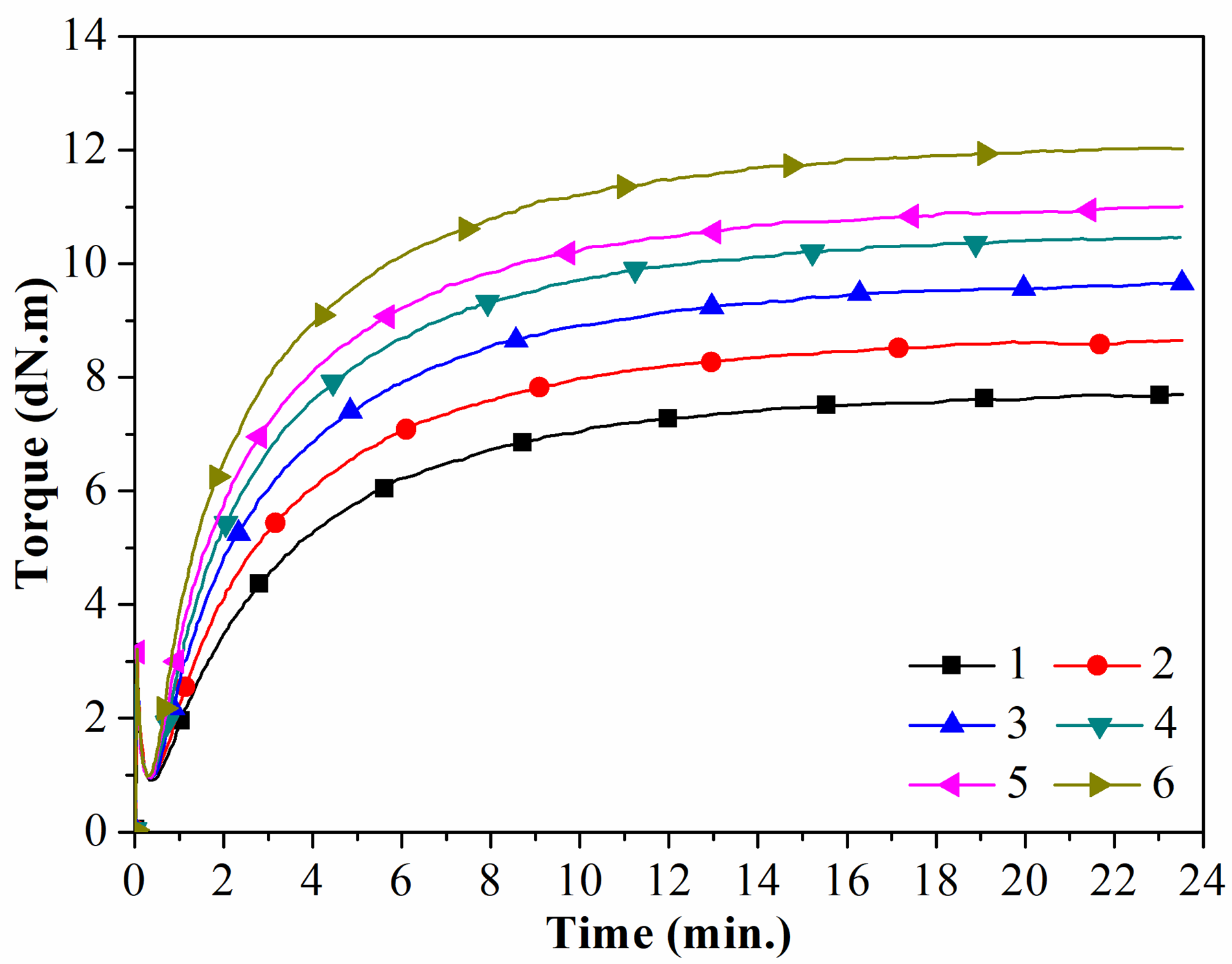
The study examines how peroxide concentration affects vulcanization behavior, cure kinetics, and crosslink density in oil–extended EPDM rubber. EPDM compounds containing 43 wt.% (75 phr - parts per hundred rubber) paraffinic oil were vulcanized with di (tert–butylperoxyisopropyl) benzene at concentrations from 4 to 9 phr. Vulcanization characteristics were evaluated using moving die rheometry over the 160–190 °C range, and kinetic parameters were determined by first–order kinetic analysis and Arrhenius modeling. Crosslink density was assessed by equilibrium swelling using the Flory–Rehner equation. Scorch safety was evaluated using Mooney scorch testing at 135 °C. The results showed that increasing peroxide concentration significantly increased the maximum torque and reduced the molecular weight between crosslinks, indicating the formation of a denser crosslinked network. In contrast, the minimum torque remained nearly unchanged. The vulcanization rate constant increased markedly with temperature but showed negligible dependence on peroxide concentration, whereas the activation energy remained within a relatively narrow range (120–125 kJ/mol). Higher peroxide concentrations resulted in more extensive crosslinking, suggesting improved radical utilization during vulcanization. At the same time, increasing peroxide concentration reduced scorch safety. Overall, the results demonstrate that peroxide concentration primarily controls the extent of network formation, whereas temperature predominantly governs the kinetics of vulcanization in oil–extended EPDM systems.
Downloads
Downloads
Published
Issue
Section
Categories
License
Copyright (c) 2026 Simona Nikolova, Mihail Mihaylov

This work is licensed under a Creative Commons Attribution 4.0 International License.
Authors are permitted and encouraged to post their work online (e.g., in institutional repositories or on their website, social networking sites, etc).


 © SET Journal