
Electric Vehicle Trajectory Tracking Prediction Using an IPSO-Optimized Bi-LSTM Model
DOI:
https://doi.org/10.54327/set2026/v6.i2.356Keywords:
Bidirectional long short-term memory (BiLSTM), Improved particle swarm optimization (IPSO), Gated recurrent unit (GRU), Electirc vehicle, Trajectory trackingAbstract
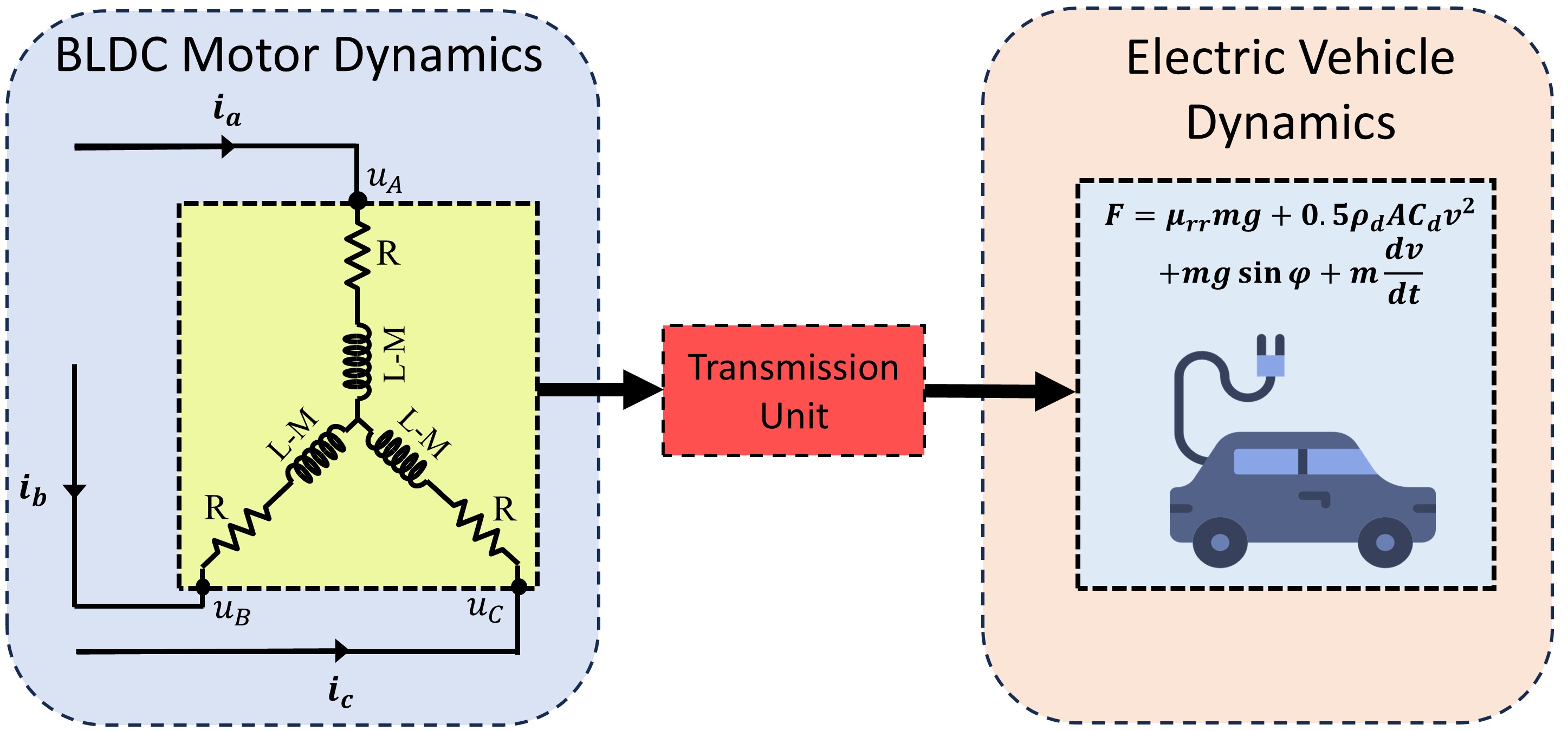
This study investigates electric vehicle (EV) trajectory tracking prediction using a bidirectional long short-term memory (Bi-LSTM) model optimized by an improved particle swarm optimization (IPSO) algorithm. The prediction task is formulated using model-generated driving-cycle data obtained from an EV dynamic model coupled with a brushless DC (BLDC) motor model. In this work, trajectory tracking prediction refers to the time-series response of the EV model under standardized driving-cycle profiles rather than real-time traffic-aware route planning. The considered driving-cycle profiles include nine standardized driving cycles, which are detailed in the experimental section. A one-step-ahead forecasting setting is adopted for the prediction task. The IPSO algorithm is employed to tune the Bi-LSTM hyperparameters and reduce the dependence on manual trial-and-error selection. The proposed IPSO-Bi-LSTM model is compared with long short-term memory (LSTM), gated recurrent unit (GRU), conventional Bi-LSTM, and other optimizer-linked Bi-LSTM models using mean absolute error (MAE), mean squared error (MSE), root mean square error (RMSE), and mean absolute percentage error (MAPE). The results, averaged over 10 independent runs, show that the IPSO-Bi-LSTM model achieves the lowest prediction errors among the compared models, with an MAE of 0.214 ± 0.009, MSE of 0.102 ± 0.005, RMSE of 0.332 ± 0.010, and MAPE of 0.082 ± 0.005%. The battery-related variables, including state of charge, current, and voltage, are reported as simulation-derived indicators associated with the predicted EV response. The present study is limited to model-generated data, and future work will focus on validation using real-world EV trajectory measurements.
Downloads
Downloads
Published
Data Availability Statement
All data generated or analysed during this study are included in this article.
Issue
Section
Categories
License
Copyright (c) 2026 Mustafa Wassef Hasan

This work is licensed under a Creative Commons Attribution 4.0 International License.
Authors are permitted and encouraged to post their work online (e.g., in institutional repositories or on their website, social networking sites, etc).


 © SET Journal