
A Machine Learning Framework for Predicting Airport Airside Key Performance Indicators and Analysing Statistical Relationships Across European Airports
DOI:
https://doi.org/10.54327/set2027/v7.i1.489Keywords:
Airport airside, Key Performance Indicators, Machine Learning, Feature importance, Airside OperationsAbstract
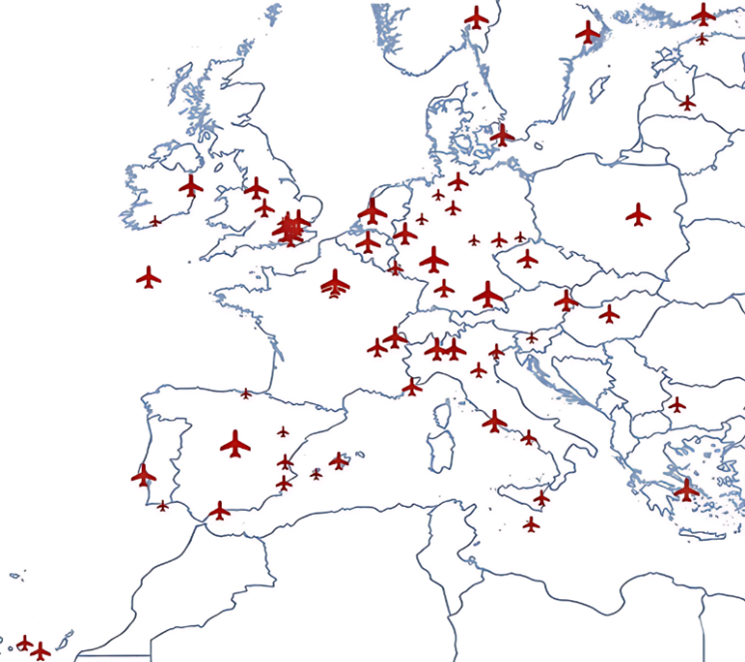
The objective of this study is to predict nine EUROCONTROL airport airside KPIs (key performance indicators) using historical monthly airport-level data and to identify statistical relationships between airport infrastructure, operational characteristics, and KPI performance using supervised machine learning algorithms with feature importance analysis across multiple European airports. Nine EUROCONTROL airside KPIs were selected as prediction targets, using monthly data from 76 European airports (2018–2019), comprising 1,824 observations per KPI after preprocessing. The input variables were airport airside features. Several supervised machine learning regression algorithms, including Multiple Linear Regression, Support Vector Regression, Random Forest, Gradient Boosting, and Extreme Gradient Boosting (XGBoost), were tested and evaluated for KPI prediction. Model performance was assessed using standard regression metrics, including the coefficient of determination (R²), Mean Absolute Error (MAE), and Root Mean Squared Error (RMSE). Model validation was performed using cross-validation and an independent test set to assess the generalisation performance of the models. To improve the interpretability of the predictive framework, feature importance analysis was performed to identify the relative contribution of individual airport characteristics to each predicted KPI (illustrated for the ATOT indicator). The results showed that the machine learning models achieved different levels of predictive performance across the nine KPIs, and that nonlinear ensemble methods generally provided stronger predictive performance than linear regression models. The proposed model highlights the potential of machine learning for predicting airport airside performance and analysing relationships between infrastructure and operational characteristics.
Downloads
Downloads
Published
Issue
Section
Categories
License
Copyright (c) 2026 Muharem Šabić, Edvin Šimić

This work is licensed under a Creative Commons Attribution 4.0 International License.
Authors are permitted and encouraged to post their work online (e.g., in institutional repositories or on their website, social networking sites, etc).


 © SET Journal