
Evaluating Machine-Learning-Driven Power and Channel Adaptation for Balancing Interference and Energy Efficiency in Multi-Environment IoT Communication Networks
DOI:
https://doi.org/10.54327/set2027/v7.i1.371Keywords:
IoT networks, interference mitigation, energy optimization, machine learning, Monte Carlo simulation, multi-environment analysisAbstract
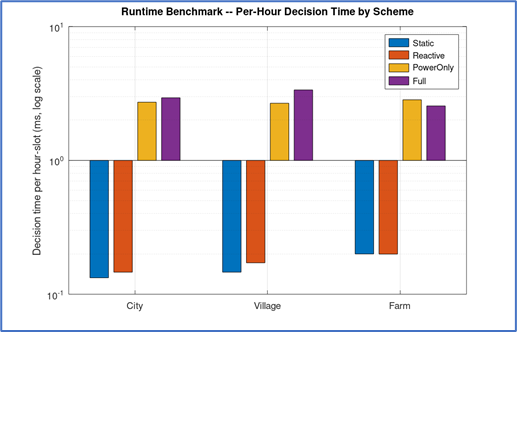
Interference and energy consumption are tightly coupled constraints in resource-limited Internet of Things (IoT) deployments. This study presents a simulation-based feasibility assessment of a machine-learning (ML)-assisted power-and-channel adaptation scheme, evaluated through a physically grounded Monte Carlo framework rather than field deployment. The framework combines a power-law path-loss channel, a Poisson interferer field, a signal-to-interference-plus-noise ratio (SINR)-based packet-delivery-ratio model, and a four-component energy model covering transmission, reception/acknowledgment, medium access control (MAC) backoff, and idle listening. After a training phase of 30 days, a linear interference-ratio predictor and a logistic high-interference classifier were fitted, and then three synthetic deployment profiles (City, Village, and Farm) were simulated on 20 independent 24-hour Monte Carlo runs for each. Four control schemes were compared: a static baseline, closed-loop reactive power control, a predictive power-only control and the full predictive power-and-channel-sensing control. Idle listening accounted for 99.2–99.9% of the daily energy in every scheme and environment. The full scheme delivered all packets in every run and, compared with the static baseline, lowered daily energy by an amount that was statistically significant (p < 0.001) but small in practice, namely 0.03–0.14% of the daily budget. The interference regressor explained essentially none of the variance (all R² values slightly below zero), and the high-interference classifier almost never identified the minority class. Models trained in one environment also transferred poorly to the other two. Although largely negative, these findings clarify what lightweight ML-assisted adaptation can realistically deliver, and they point to duty cycling and richer predictive features as the most useful directions for further improvement.
Downloads
Downloads
Published
Issue
Section
Categories
License
Copyright (c) 2026 Zeyid T. Ibraheem, Nassma M. Ammar, Mohammed Aboud Kadhim

This work is licensed under a Creative Commons Attribution 4.0 International License.
Authors are permitted and encouraged to post their work online (e.g., in institutional repositories or on their website, social networking sites, etc).


 © SET Journal